
Why Fonzer fully chooses AI telephony: the story, motivations, and strategy behind transcriptions and virtual assistants
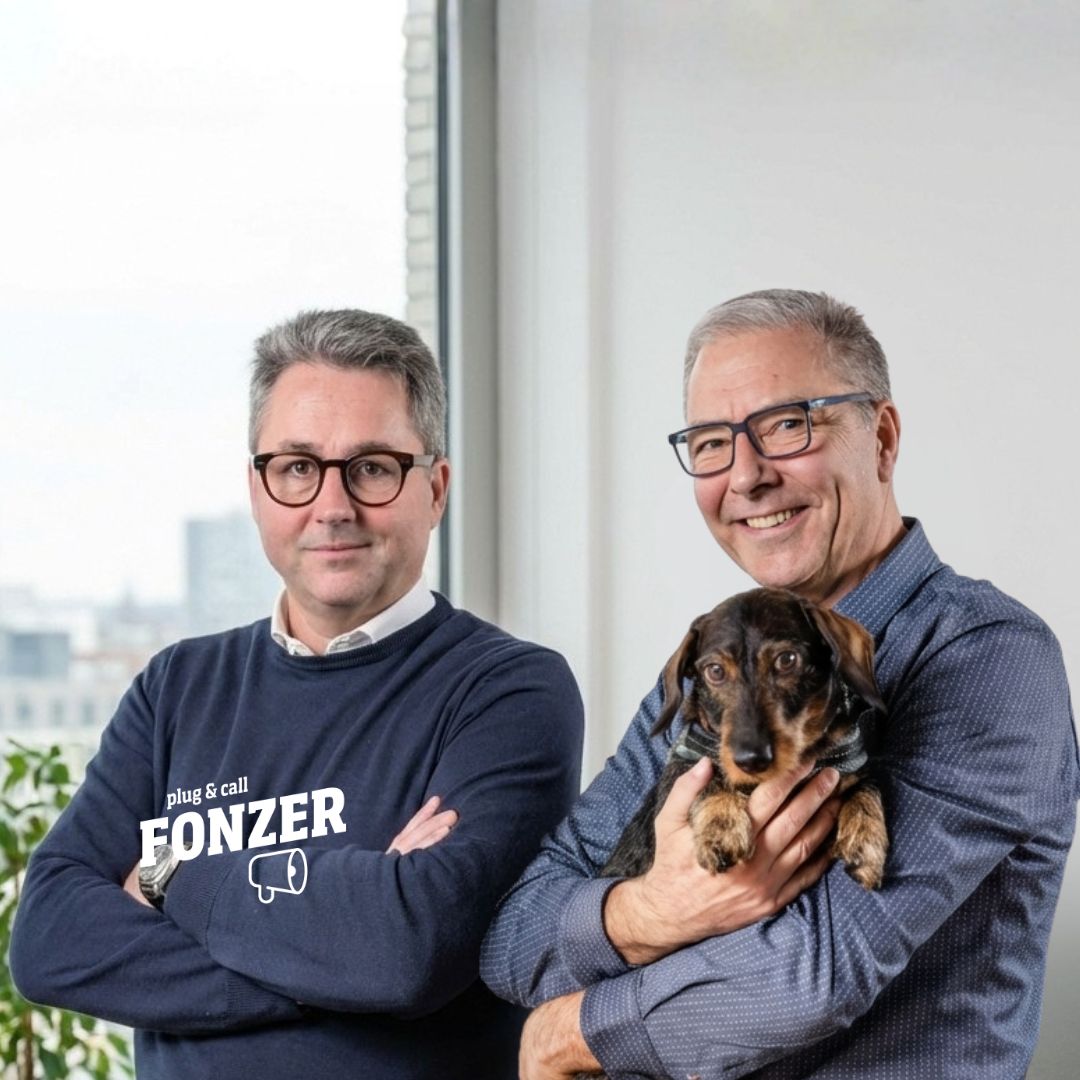
Fonzer is built on a love for user-friendly telephony and the ambition to make business communication smarter, more human, and future-oriented. In this interview, founders and partners Kristof Dedeyne and Ben Holemans share how it all started, why they are so focused on AI features, and where Fonzer is heading.
How Fonzer started
Question: Kristof, when was the seed for Fonzer planted?
Kristof: "Based on my 30 years of customer contact around business telephony, I have a solid view of how business communication should work. No bulky hardware, but a flexible platform you can configure to fit your company. That immediately became the technological foundation on which Fonzer as its own brand was built."
Question: Ben, why launch your own brand instead of remaining a classic integrator?
Ben: "Because we saw that many Belgian companies were looking for something different from pure technology. They wanted a telephony system that feels like it was made for them, with an interface everyone can use and integrations that truly make sense. Fonzer was created to fill exactly that gap: a unified cloud communications platform that is both highly technical and wonderfully human."
Personal motivations
Question: What personally drives you to go all in on this?
Kristof: "For years, telephony has been a necessary evil. Contracts, devices, limitations. We get excited when companies suddenly realize telephony can be fun and smart again. Every time a customer says, 'I should have done this years ago,' we know why we do it."
Ben: "For me, it is about impact on the workday of real people: planners, reception staff, support, sales, business owners. When you see how much noise, duplicate calls, and manual retyping we can eliminate, it gives energy. We want to build a platform that gives teams breathing room while IT still keeps full control."
Why such a strong focus on AI features
Question: You position Fonzer as a telephony platform that excels in AI applications. Why such a sharp focus?
Ben: "Because classic cloud telephony is mainstream by now. The real accelerator lies in what you do with conversations after someone has picked up. With transcriptions, summaries, and our Tringer virtual assistant, we turn every conversation into structured data. That is gold for customer service, sales, and planning."
Kristof: "We do not want to be just another player with the same calling bundles and devices. Our differentiation is clear: telephony is the foundation, AI is the distinction. Things like automatic transcription, smart summaries, booking appointments via voicebot, and triggers to CRM or planning tools are not gimmicks, but everyday helpers."
Transcriptions as the new standard
Question: What makes transcriptions so important in the strategy?
Ben: "Transcriptions remove all the stress from 'I missed something.' Teams no longer need to half-take notes or relisten to calls. They get a clear text and often an immediate summary with actions in it. That is a win for support, sales, quality, and compliance all at once."
Kristof: "Transcriptions also form the foundation for better service over time. You discover recurring questions, the words customers use, and where processes are stalling. With that, you can improve FAQs, scripts, and even your product. Without transcriptions, all of that stays in people’s heads and notes."
Virtual assistants with a Belgian accent
Question: You often talk about virtual assistants and an AI voicebot. What is the vision behind that?
Kristof: "We are building a voicebot that behaves like a digital colleague, with a Flemish accent. Many bots still sound too generic or too foreign. We want a Flemish company to feel that the bot belongs to the team, not to an anonymous call center somewhere far away."
Ben: "The virtual assistant takes over repetitive and boring phone calls: address confirmations, opening hours, simple appointments. If it becomes complex or sensitive, the bot transfers live to an employee, with context and transcript. That way, people get the interesting conversations and AI does the rest."
The strategy behind Fonzer
Question: How would you summarize Fonzer’s strategy today?
Ben: "Very concretely: the most loved business telephony from SMEs to multinationals, with AI as the turbo. We focus on direct customers, strong partners, and software solutions that integrate Fonzer into their own tools. In doing so, we focus on 'the innovators': customers who immediately see value in transcriptions, virtual assistants, and integrations."
Kristof: "We deliberately choose focus. Not a telecom jack-of-all-trades, but a telephony platform that excels in integration and smart AI features. Our API, our security, and our AI layer are strategic building blocks. This allows partners and customers to use Fonzer as a foundation to build their own industry solutions."
Future: where Fonzer wants to go
Question: Where do you see yourselves in a few years?
Kristof: "By then, it will be self-evident for Belgian service companies that every call is automatically transcribed, summarized, and linked to their tools. And that when they think of 'AI telephony,' they immediately think of Fonzer."
Ben: "We want to be the reference platform for companies that no longer see telephony as a cost, but as a source of data, insights, and automation. Work hard, put in the miles, respect each other, and enjoy life is not a slogan for us: it is the bar we hold Fonzer to every day."